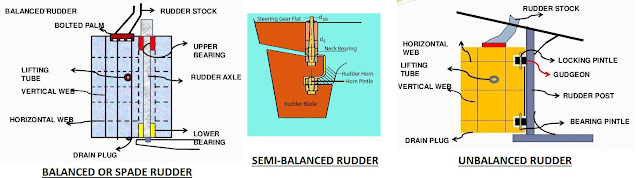
Types of Rudders


Spade or balanced rudder:

A rudder has 20-40% of the area forward of the stock, similarly there is no torque on the rudder stock at certain angles and it is called balanced. The axis of the rudder is placed near to the center of gravity, so torque required to move the rudder will be very less.

Semi-balanced rudder:

A rudder with 20% of its area forward of its stock is called semi-balanced rudder. It is often found in twin screw ships. In this at no angle, rudder is balanced.

Unbalanced rudder:

A rudder with whole of its area aft of its stock is called unbalanced. In this at no angle, rudder is balanced

Comments

Popular posts from this blog

Manganese bronze is not typically used as a propeller material .Why

1. High cost: Manganese bronze is a costly alloy, making it less economical for large propellers. 2. Low strength-to-weight ratio: Compared to other propeller materials like nickel-aluminum bronze or stainless steel, manganese bronze has a lower strength-to-weight ratio. 3. Susceptible to corrosion: Manganese bronze can corrode in seawater, especially when exposed to high velocities and turbulence. 4. Poor cavitation resistance: Manganese bronze is more prone to cavitation damage than other materials. 5. Difficult to cast and machine: Manganese bronze is challenging to cast and machine, making it less desirable for complex propeller geometries. 6. Limited weldability: Manganese bronze has poor weldability, making repairs and modifications difficult. Nickel-aluminum bronze or stainless steel are commonly used for propellers due to their: - High strength and durability - Excellent corrosion resistance - Good cavitation resistance - Ease of casting and machining - Weldability

MAN B&W MC Engine VIT Pump

The pump is basically a jerk type with a plunger moving in a matched barrel, using two helical grooves machined in the plunger to control the end of injection by uncovering spill ports and causing the discharge pressure to drop rapidly, thus causing the needle valve in the injector to close. Oil is supplied to the barrel via the spill ports and a suction valve. The suction valve, situated at the top of the barrel opens when the pressure in the  barrel falls below the supply pump pressure; i.e. during downward stroke of plunger, while spill ports are covered by plunger. Replaceable erosion plugs  are fitted in the pump housing opposite the spill ports. The high pressure oil, spilling back, as the edge of the helix uncovers the s...

Shell Expansion Plan

It is a two dimensional drawing of a three dimensional surface of the ship’s hull form. This plan is very useful for the following information:It is used for marking the location of a hull Damage on this plan by identifying the strake number , letter and frame number so that the exact location of the damage and also suggested repairs are marked in a localised copy. The shell expansion can be used for finding areas of painting surfaces such as topside, boot topping and bottom areas by applying Simpsons rules directly.  In the shell expansion the vertical scale used is different from the horizontal scale and a suitable adjustment has to be made when calculating areas. This becomes useful in solving disputes concerning areas of preparation and painting. It gives information on the thickness of the original strake which is indicated by the number in the circle shown in the strake.  The quality of steel used is also shown by letters A,B,D E and AH, BH,DH, EH.