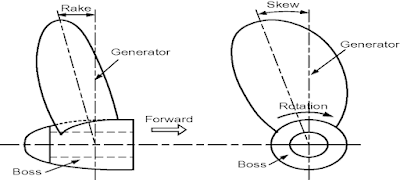
RAKE and SKEW of propeller


RAKE:

  • When the propeller is viewed from sideways, we see that the blades of the propeller are not perpendicular to the surface of the hub. It is ‘tilted’ at an angle either towards the fore-end or the aft end of the ship. This is termed as Rake. 
  • One of the biggest reasons for the rake is allowing higher clearance between the blades and the vicinal hull surface. If the blade tip happens to be very close to the hull plating (which is very prone in case of no or little raked ones), there is a chance of induced vibration due to ship propeller action. 
  • When the blade is raked forward, that is in the direction of the shaft axis towards fore-end, it is called Negative Rake. Conversely, when it is raked aft, it is called Positive Rake 

SKEW: 

  • When we look at the ship propeller surface from behind). The blade appears to be ‘Skewed’, that is, bent or twisted sideways. 
  • After years of experimentation, analysis and sea trials, it was observed that aptly skewing a ship propeller nullifies or considerably minimises the extent of unsteady hydrodynamic loading in this flow field. This indirectly has positive effects in reducing resistance due to viscous ‘drag’ effects. It also reduces propeller-induced vibrations. 
  • Reduction in unsteady bearing forces and moments. 
  • Reduction in unsteady pressure forces.

Comments

Popular posts from this blog

Main engine interlocks

Interlocks are provided so that the engine can be started or reversed only when certain conditions have been fulfilled. When there is a remote control of engines, it is essential to have interlocks. This reduces the possibility of engine damage and any hazards to the operating personnel. Turning gear Interlock . This device prevents the engine from being started if the Turning gear is engaged. Running Direction Interlock . This prevents the fuel from being supplied if the running direction of the engine does not match the Telegraph. Starting Air Distributor in end position . This prevents starting from taking place if the shifting of the Distributor has not been completed. Main Lube. oil pressure, Piston cooling pressure, Jacket water pressure, and important parameters must be above the required minimum. Auxiliary Blower Interlock . The Auxiliary Blower is provided in case of Constant pressure turbo charging. Air Spring pressure Interlock . In case of the present generation...

Differences between MC/MC-C and ME/ME-C engines

The electrohydraulic control mechanisms of the ME engine replace the following components of the conventional MC engine: Chain drive for camshaft Camshaft with fuel cams, exhaust cams and indicator cams Fuel pump actuating gear, including roller guides and reversing mechanism Conventional fuel pressure booster and VIT system Exhaust valve actuating gear and roller guides Engine driven starting air distributor Electronic governor with actuator Regulating shaft Engine side control console Mechanical cylinder lubricators. The Engine Control System of the ME engine comprises: Control units Hydraulic power supply unit Hydraulic cylinder units, including: Electronically controlled fuel injection, and Electronically controlled exhaust valve activation Electronically controlled starting air valves Electronically controlled auxiliary blowers Integrated electronic governor functions Tacho system Electronically controlled Alpha lubricators

Manganese bronze is not typically used as a propeller material .Why

1. High cost: Manganese bronze is a costly alloy, making it less economical for large propellers. 2. Low strength-to-weight ratio: Compared to other propeller materials like nickel-aluminum bronze or stainless steel, manganese bronze has a lower strength-to-weight ratio. 3. Susceptible to corrosion: Manganese bronze can corrode in seawater, especially when exposed to high velocities and turbulence. 4. Poor cavitation resistance: Manganese bronze is more prone to cavitation damage than other materials. 5. Difficult to cast and machine: Manganese bronze is challenging to cast and machine, making it less desirable for complex propeller geometries. 6. Limited weldability: Manganese bronze has poor weldability, making repairs and modifications difficult. Nickel-aluminum bronze or stainless steel are commonly used for propellers due to their: - High strength and durability - Excellent corrosion resistance - Good cavitation resistance - Ease of casting and machining - Weldability